
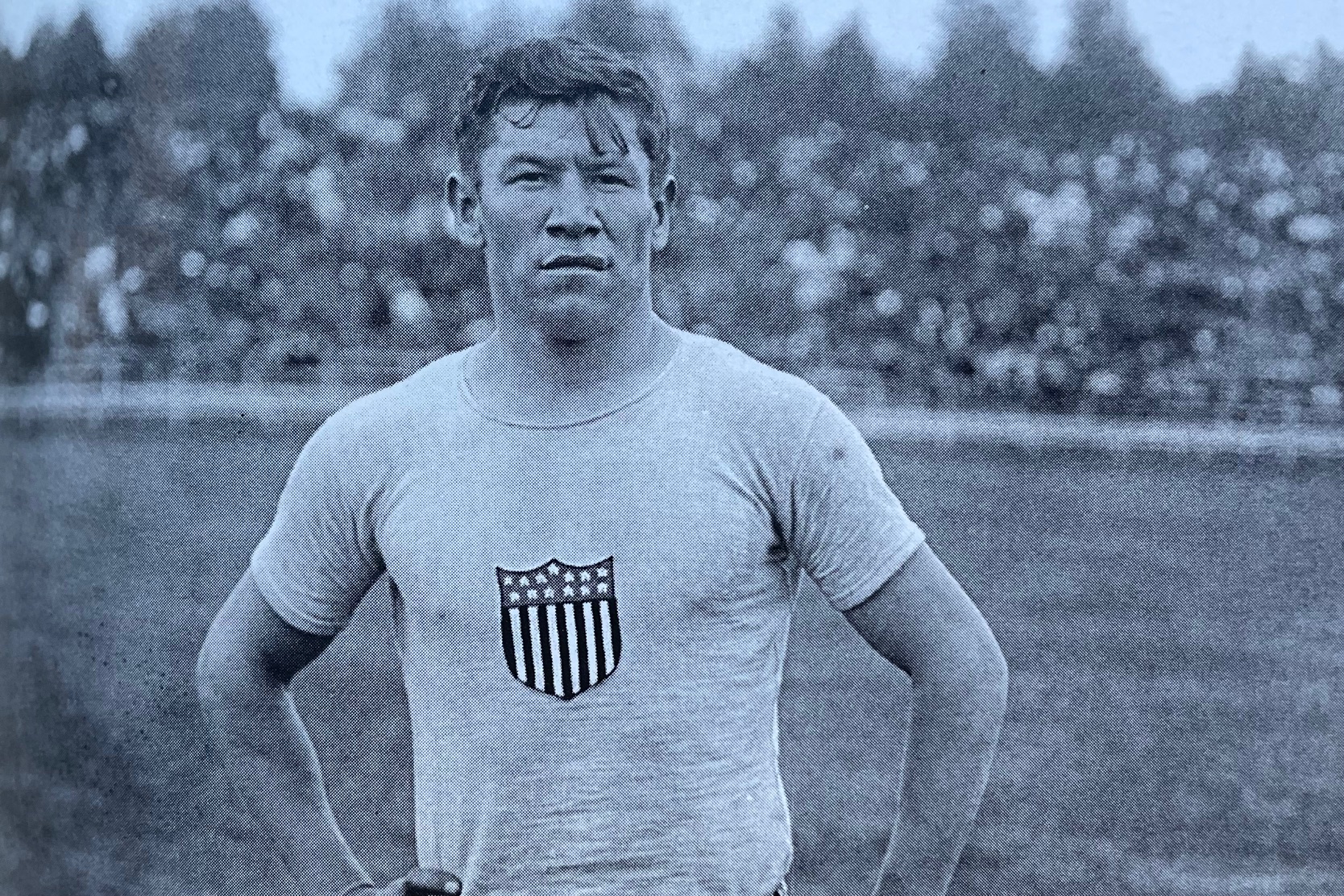
Yes, His was a Path Lit by Lightning
The greatest athlete who ever lived? I think he was. He was one of my mythical idols as a young boy of the ’50s and ’60s. A two-time Olympic gold medalist, a two-time All-American halfback, Pro Football Hall of Famer, and major league baseball player, skilled ice skater, scratch golfer, national champion ballroom dancer, he was everything and more one would envision for a man whose path was lit by lightning.
His given name was Wa Tho Huk – Path Lit By Lightning; a truer foretelling of his life could not have been manufactured. An American Indian of the Sac and Fox nation, Jim Thorpe was born in the age when white America was determined to destroy the Indian by forcefully indoctrinating him. Like black Americans, American Indians were thought to be inferior – savages who had neither the will nor the intelligence to achieve or do great things.
Most tribal children of his era (he was born in 1887), were shipped off government run Indian schools to be cleansed of their red man ways and brought forth into the light of civilization. At the very least it was condescending, at its worst it was cruel and inhumane. Thorpe was sent to the Carlisle Indian Tribal School in Pennsylvania, where his athletic prowess was discovered and exploited by the famous football coach, Pop Warner.
Should you doubt his standing as the greatest all-around athlete, think on these things. In his age, no one came close. He was ballyhooed over and over as untouchable. He had the look of an elite athlete. He could do things for the first time others couldn’t do after years of practice. As a running back he was fast, elusive, powerful; he could punt a football 100 yards, kick fifty-five yard field goals and drop-kicks (now a lost art). He was named to the all-half century college football team in 1950.
Some questioned his skills as a baseball player, but those who played with him didn’t. His biggest issue with baseball was the famous New York Giants manager, John McGraw. McGraw used, abused and discriminated against Jim, never giving him a fair chance, breaking promises, and using him as a promotional tool. Once Thorpe was traded to the Boston Braves, he hit .327. After six years of manipulation, he escaped McGraw’s hold and became a daily player in triple-A baseball, where he hit for power and average, several times over .400.
As the gold medalist in the pentathlon and the decathlon at the 1912 Olympics, he was literally a one-man track and field team. He won the pentathlon using stray, mis-matched track shoes when someone stole his regular spikes, and it wasn’t even close. He won four of the five events, taking the 200 meter dash, the broad jump, the discus and the 1,500 meters. He was only fourth in the javelin, an instrument he had never thrown until two months before the Olympics. His total score was 7 (low score wins); the second place finisher scored 21.
He competed in the decathlon for the first time at the Olympics, setting a world record by scoring 8,413 points. His closest rival was a huge 700 points behind. Thorpe had dominated again by winning three of the ten events, was top three in seven, and never finished worse than fourth out of fifty competitors. His least favorite event was the pole vault, as he feared the bamboo poles of the time would break under the tremendous power he generated.
You may recall the following year he was stripped of his gold medals by the US Amateur Association for playing semi-pro baseball during a summer break from school. He was doing what all college players at the time did – play for a summer job. His duplicitous handlers and the head of the AAU knew of his baseball playing, only to deny it when the scandal broke. Thorpe knew nothing about it being an issue; he did as he was encouraged to do to by Pop Warner and the school.
It was a travesty made worse by the bigoted hypocrisy of Avery Brundage, the long-time head of the US Olympic Committee, who happened to be shamed by his poor performance in the same Olympic decathlon event won by Thorpe. It wasn’t until 1983, thirty years after Thorpe’s death, that the International Olympic Committee restored Thorpe’s gold medals.
Thorpe’s life was one long battle against prejudice, deceit, bad deals, alcohol, and misplaced loyalties. Yet he never lost faith that he could overcome the odds. He tried many times to leverage his fame into a successful business venture, but society and those he trusted sabotaged his chances. Instead, the years found him retreating over and over again back to the sports he loved for money and promotions to scrape together a living.
At the age of forty-seven he was still playing barnstorming baseball across the mid-west and east coast, hitting over .400, clubbing prodigious home runs as a player-coach – and never getting paid a penny by the unscrupulous promoter. That happened to Jim many times over the years, the victim of promises unkept and wages unpaid, and despite lawsuits, with no recourse to collect.
He was a man whose financial opportunities should have been plentiful, yet his life was marked by money troubles and a constant fight to overcome discrimination, betrayal, duplicity, shysters and liars. Throughout his life he remained popular and revered by the public even though sportswriters disrespected him and opportunistic promoters took advantage of him.
Imagine how much more he could have done for the world if given the opportunity. At times, he was his own worst enemy by not being more vigilant about money. He was burned so many times by both reputable and irreputable organizations and individuals. But he kept looking for opportunities and work. Sad. He deserved so much better than to die at 65, nearly destitute, of a massive heart attack in a trailer home. 1953. The year I was born.
I know today’s athletes are more skilled, better trained, and have better science and equipment behind them. Direct comparisons can’t be made. All we can do is compare great athletes of their age against those around them. Thorpe was one-of-a-kind.
No one could adapt and master a sport as effortlessly and completely as he could. Pop Warner said it was uncanny how Jim could observe how someone did something and almost immediately replicate it as well as the best. He was thoughtful, analytical, and even an activist for his ethnicity, especially in the Hollywood film industry, where the American Indian was routinely disrespected and ignored.
What I get from looking at the life of Jim Thorpe is not only great admiration for his athletic prowess, but his personal pride and nobility. He never lost that, and for all his challenges and disappointments, I find that admirable and impressive. If only we all had his strength. Maybe that came from being born on a night where the path was lit by lightning.