Appreciating our Ability to Remember
I was hit with a serious bout of nostalgia this morning. You know, the bittersweet kind. The kind where your mind wanders down the trail of your youth, even of your parent’s youth. Of what it was like to live and survive a hundred years ago, during the Great Depression. When I was a kid that seemed almost incomprehensible. Now it’s close enough to my own childhood that I feel a connection.
I harken back on how simple and plain the houses were. How my father, his brothers and sister, and my grandparents lived, all seven of them stacked up in that little 1,200 sq ft house with its west facing little sun porch and the east facing enclosed back porch. With its single, tiny bathroom and two bedrooms, where the main room was the kitchen, where the living/dining room was relatively long and narrow.
I think about the clapboard garage outback, situated longways beside the gravel alley, so that the barndoor slid along the long side of the weathered, unpainted wall and his 1954 Ford Victoria came out at an angle. That’s the car I remember as a five year old visiting my grandparents. Snooping around his barren, dirt floor garage with its open rafters, no lighting, and dank, old barn feel. That big old two-door, aquamarine Ford with its huge chrome bumpers and chromed slab sides and couch-like bench seat, standing silently by while I marveled at it, remembering the last time grandpa let me sit on his lap and steer.
And I remember visiting the little cement block fabricator where he worked just a few blocks away, making building blocks, piping and other construction pieces. What a surprise – everything there was either weathered wood or grey. It was anything but glamorous, but it was a job. In the depression, having one was something.
Years later I remember, too, my aunt’s ingrained habit of wiping the inside of every eggshell with her middle finger to extract every last bit of egg white. You do that when eggs are precious and each of you only get one. I think of it every time I cook eggs.
My grandmother’s favorite place was her enclosed back porch with the wood-framed screen door, the wall of windows and the sunny yellow paint that captured and amplified the morning sun. She would putter around the various tables and shelves caring for her plants and flowers, and sit in the wicker rocker with the occasional book. She seemed the most content there.
Of our own houses, I remember living in the little Sand Point family student housing at the University of Washington while my father finished his master’s degree on the GI bill. He worked nights at a Chevron gas station to make living money. Then there was our year or so in Holly Park subsidized housing, just down the lane from the prostitutes who lived there. Both those places were not much more than a series of apartments built in a long house style during the war. Sand Point had the aromatic advantage of bordering the landfill along the Lake Washington wetlands. It was about as simple as it gets, although we did have indoor plumbing.
Once my dad graduated he landed a job at Boeing, where he would build a career lasting some thirty-eight years. We immediately moved into a three bedroom house on 59th Ave SW, a block off the water in West Seattle. I remember the neighborhood troublemaker was Victor Harvey Palmer; easy to remember because his mother yelled it often. I also remember when the city dug a huge trench down the middle of the street to install a sewer system. To a four year old, that trench looked like they were going to China and was nearly as wide as the whole street!
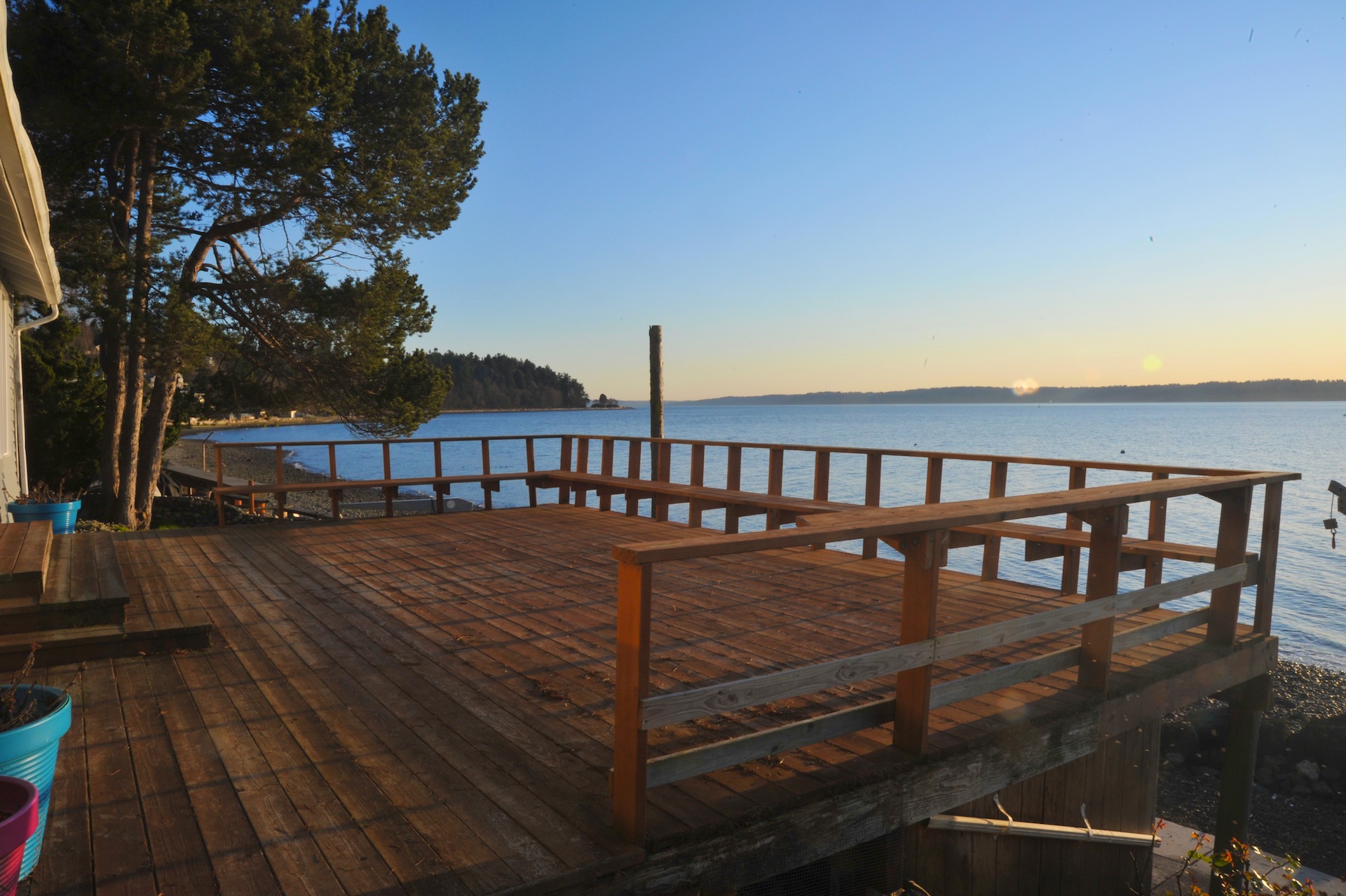
When I turned five, my parents took the plunge and fulfilled their dream of living on the beach. They bought a three bedroom, two bath home on West Seattle’s Beach Drive. To say it was a fixer upper was probably an understatement. Originally built in 1900 as a summer home, it had no central heating, no insulation, dated appliances and a yard that looked well, swamp-like. It was $150 a month. The sale price was $24,500 and the seller did my parents a favor and carried the contract.
When my dad proudly showed it off to my grandfather and asked “What do you think?” My grandfather said, “I think you’re nuts!”
We lived on hot dogs, hamburgers, and casseroles while my dad worked every spare hour on that place. A neighbor who owned an HVAC company took pity on us and installed a furnace and central heating for FREE! Can you imagine? The days of getting dressed by the gas space heater in the downstairs hall while it glowed red against the wood framing were over. Next came insulation. It was still a drafty old house, but at least we could keep warm.
Bit by bit, that whole house was remodeled, but it never did get a proper foundation. To this day it sits on post and pillar logs from 125 years ago. Other projects included my brother and I digging about 175 feet of ditch through mud, clay, rock and buried logs to hook up the sewer system the city built along the waterfront in 1968. No more septic tanks draining into Puget Sound. It was funny how the kelp beds out front shrank dramatically after that.
Then there was the building of a concrete sport court, complete with salvaged railroad ties my Burlington Northern yard superintendent uncle got for us to hold back the hillside; the water-side concrete stairs; the open, cemented and decorated stream bed into which all the french drains emptied hillside underground spring water; the removing of stumps, the creation of gardens, the tetherball court, the building of decks and a crane to lift our ski boat in and out of the water; the carpeted raft we water skied off; the paddleboards my father built, and on and on.
Vacations were for major home projects. But when you live on the water, vacation is right out your front door. I dearly loved growing up there. My sister remembers me as a sixteen year old saying one day I would live there again. And strangely enough, after my father died my mother sold me the house. We were back to my dream of living on the water, living off hot dogs and hamburgers, and loving every minute of it.
There’s plenty of nostalgia to reminisce about. I’m not sure why it has such a bittersweet taste. Maybe it’s because life was simpler then, more basic. You had to be in touch with yourself; often it was just you and your thoughts. No apparatus to take with you into the woods – no music, no computer, no phone. If you were lucky an AM radio might work. Nothing on a walk but the sound of river rock sliding beneath your shoes, leaves rustling, a crisp breeze blowing white caps and the waves lapping rocks along the shore. Now those were great days….