From Barrel Staves to High Tech
It took until 1922 before an enterprising young Minnesotan, Ralph Samuelson, invented the water ski by fastening leather straps to a couple of nine-inch wide, eight-foot long pine boards that were curved at the tip by steaming and clamping. With a hundred feet of window sash cord and a custom-made iron handle, he stood on an aquaplane board to start, then stepped onto the water once underway. He performed tricks and exhibitions, but never patented his skis. New Yorker Fred Waller did that in 1925.
The invention was unknown to Don Ibsen in Seattle, but that didn’t stop him from ‘inventing’ his own version of water skis during the summer of 1928. Two eight-inch wide by seven-foot slabs of Northwest cedar, with tips steamed and bent around a telephone pole, were sanded and shellacked to produce his first working set. In 1934 he founded Ibsen Water Skis, and he and his wife devoted decades to selling ski equipment and promoting water-entertainment events.
The 1950s, however, were when the sport really began taking off. Ibsen, naturally, was part of it, founding a ski school and a ski club on Lake Washington, and promoting the sport by appearing in Life magazine while skiing in a suit and tie on the Chicago River.
I got my first taste of water skiing as an eight-year-old in 1961. In 1958, we had moved into a fixer-upper house on the beach in West Seattle. Then my Dad bought a wood hulled, fourteen-foot boat with a 47-1/2 hp Mercury outboard; we were going to learn to ski on Puget Sound. As this was before the days of wet suits, the idea was get out of the water as fast as you could and stay out! My parents, aunts and uncles had the advantage of a few breakfast beers before taking on that 48 degree water. But the sensation of gliding over waves was almost like flying; I was hooked.
My father had purchased a Velrob, one of the original banana slalom skis. Made in Everett, WA, it was a plain, six-foot laminated mahogany ski with no fancy inlays. My friends down the beach, Roger and Grant Anderson, were three years my senior and already into water skiing. It wasn’t long before they bought the Ferrari of water skis, a Wally Burr.
Wally Burr was the godfather of water skis, first producing a banana-style ski copied from his daughter’s Austrian-built snow ski in 1952. Later he invented the first tunnel ski. He was a craftsman and a perfectionist. His skis not only performed, but the beautiful laminates and designs on the tops of his skis were works of art. Local builders flocked to his basement shop to apprentice and learn from the master. His was the ski that catapulted Seattle to becoming the world capital of water ski manufacturing.
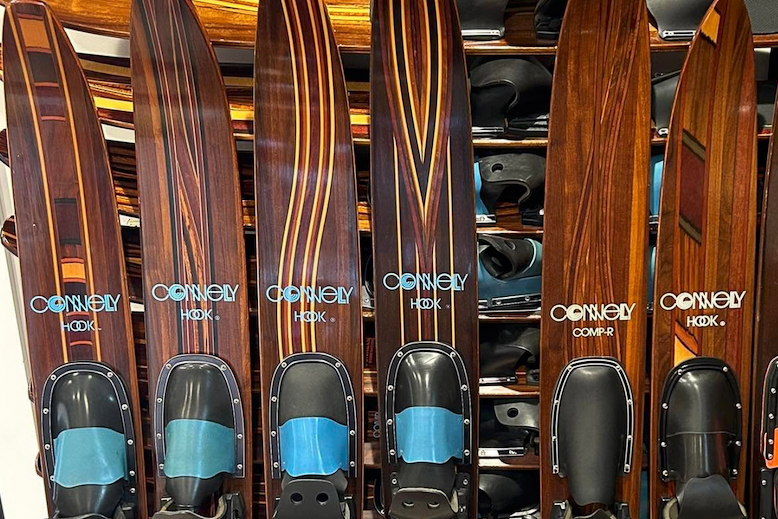
From Wally’s shop sprung the like’s of O’Brien, HO, Connelly, and Wiley. From them came Jobe, Kidder, and Terry. The first tunnel water ski I saw was made by O’Brien. By necessity it was thicker and heavier than previous skis and for that reason wasn’t my favorite. Connelly also introduced a tunnel ski that was lighter. Combined with beautiful top inlays that were even more intricate and arresting than Wally Burr’s, the Connelly was always my favorite ski.
When Connelly introduced the Hook around 1970, I was hooked. I could do no wrong on that ski. It gripped and tracked like no other slalom ski, and was the go-to for years. It didn’t hurt that some of those skis were produced in a little West Seattle garage wood shop just off Fauntleroy Way. We all knew where it was.
Herb O’Brien founded O’Brien Water Skis in 1964 after, like most everyone else, experimenting with ski-building in his family’s basement. O’Brien became a pioneer in perfecting the tunnel ski and building the company into one of the largest ski manufacturers. Then came the disaster – he was convicted of aiding and abetting the smuggling of cocaine in hollowed out O’Brien skis, losing his company and serving six years in prison before founding the highly successful HO Skis in 1981. He also later launched water sports companies Hyperlite, Radar Skis and Ronix Wakeboards. He was also famous for building Radar Lake, one of the first manmade lakes dedicated to water skiing (one of over twenty-five such lakes in Washington state) outside Woodinville.
Then there was the gregarious Paul Wiley who, like Connelly started his water ski business in 1965, next to the Boeing Research Lab (where my Dad worked) on the Duwamish river. His shop was just down the hill from West Seattle, a mere fifteen minutes from my house. I was a regular there. He was always available to talk water skiing, mentor about the business, and set anyone straight about almost anything, if you dared to ask. He was a very important figure in water skiing. His shop was a museum, crammed full of history as well as being one of the finest, best equipped ski shops anywhere.
In the spring of 1967, I built my own ski in eighth-grade wood shop. Our shop teacher had created a bonding jig and trim tools that mimicked the Terry Comp slalom ski. Everyone who had used those tools before me had opted to build a tunnel ski. Because I was also a snow skier and had studied ski construction, I had a good idea of the physics involved and the kind of ski performance I wanted. Preferring a lighter, more responsive water ski, I chose to forgo the tunnel and build a ski that was the same thickness as my dad’s Velrob ( only 5/8″).
Because it was spring quarter, there was less wood stock to choose from, but I found an adequately wide board of walnut, with which I inlaid ash and eastern red cedar for the top, and bonded that to a solid piece of walnut for the bottom. Once out of the press, I carefully trimmed down the sides so it was slightly narrower (for quicker edge-to-edge transition) than a standard Terry, and precisely chamfered the sides so the edges would give good bite across the water. Three coats of polyurethane varnish, an O’Brien drop-through fin and a set of Wiley competition bindings and it was ready to go.
That ski turned out to perform exactly as I had hoped. It was quick to edge, had a positive bite and steered like a sportscar. Because it was thinner, it didn’t tolerate rougher water as well as the tunnel skis, but I wasn’t particularly interested in skiing on rough water anyway. I skied thousands of runs with that ski for over twenty years before I finally snapped it one day while skiing on Lake Sammamish in 1988. That was a sad day.
At one time, over 80% of the world’s water skis were manufactured around greater Seattle. But, being located in an aerospace and snow skiing epicenter, by the mid-1970s water skis began imitating snow skis, using fiberglass as the preferred material. Carbon fiber, foam cores, and thermoplastics soon followed, permanently replacing the art and craftsmanship of building with wood with the efficiency and volume of mass production. Relocation to manufacturing overseas came next. By the 1990s, the romance of skiing on a work of art, or something you had built, was over.